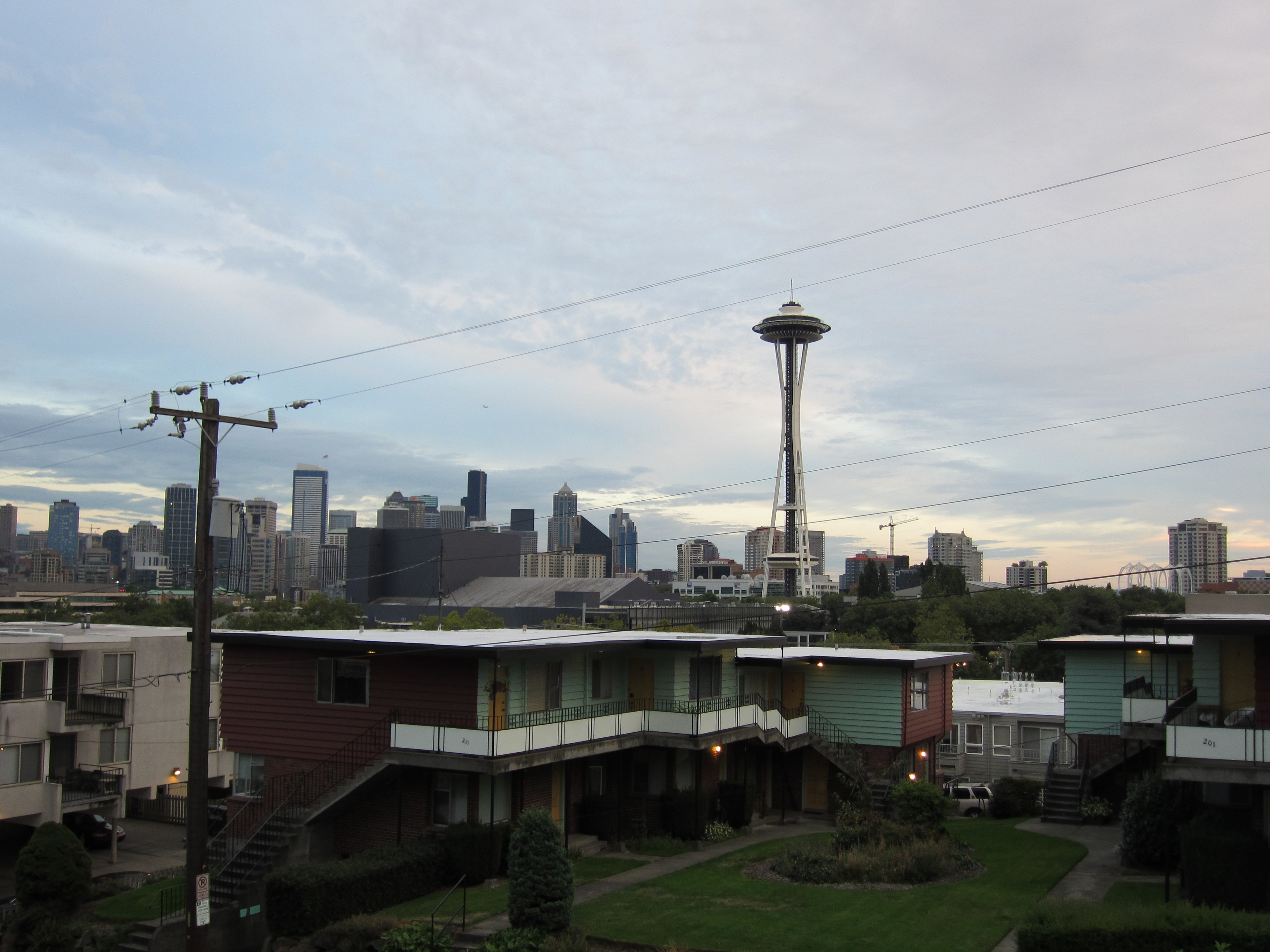
Looking towards downtown from Eleanor's apartment. Bizarrely, when I visited last fall, I stayed at a hotel about 3 blocks from here...
Looking towards downtown from Eleanor's apartment. Bizarrely, when I visited last fall, I stayed at a hotel about 3 blocks from here...
Comments
When I am king, I will call for the removal of all utility pools and wires attached thereto. Find another way, people! Why can't the world be wireless??
— Margaret Hovell
Agreed. Ruins the picture, but they were hard to avoid...
— Catherine Hovell
NPR had a segment on this a few weeks ago. A lot more expensive (an order of magnitude was the term thrown around) and no one is willing to pay for it in the U.S.
— John Hovell
It still seems to me that the benefit in times of distress (e.g., no downed lines in big storms) and the ability to constantly support the wires (no sag) would offset the costs... dig a trench, drop a big concrete tube, run wires, cover with dirt. Install access doors.
— Catherine Hovell
It would be nice if it were true (I sure dislike overhead power lines) but I think the economics don't work even factoring storms and reliability into the equation (something that people are bad at valuing to begin with). You need to do a lot more than bury a concrete tube: for instance it can't be allowed to flood, and all the materials and fixtures have to be designed for very high voltage which is expensive. I think this is the piece I heard on NPR about a month ago: http://www.npr.org/2011/08/29/140042767/would-burying-power-lines-reduce-power-outages
— John Hovell
I back up John on this one. Before we left Darien - they buried a high voltage main line through Darien. The numbers escape me - but it was many multiples of what an overhead would have cost. I think that it was $ 110m - but I do not know how much of the project this price covered (it started in N Norwalk and ended in E Stamford).
— Peter Hovell