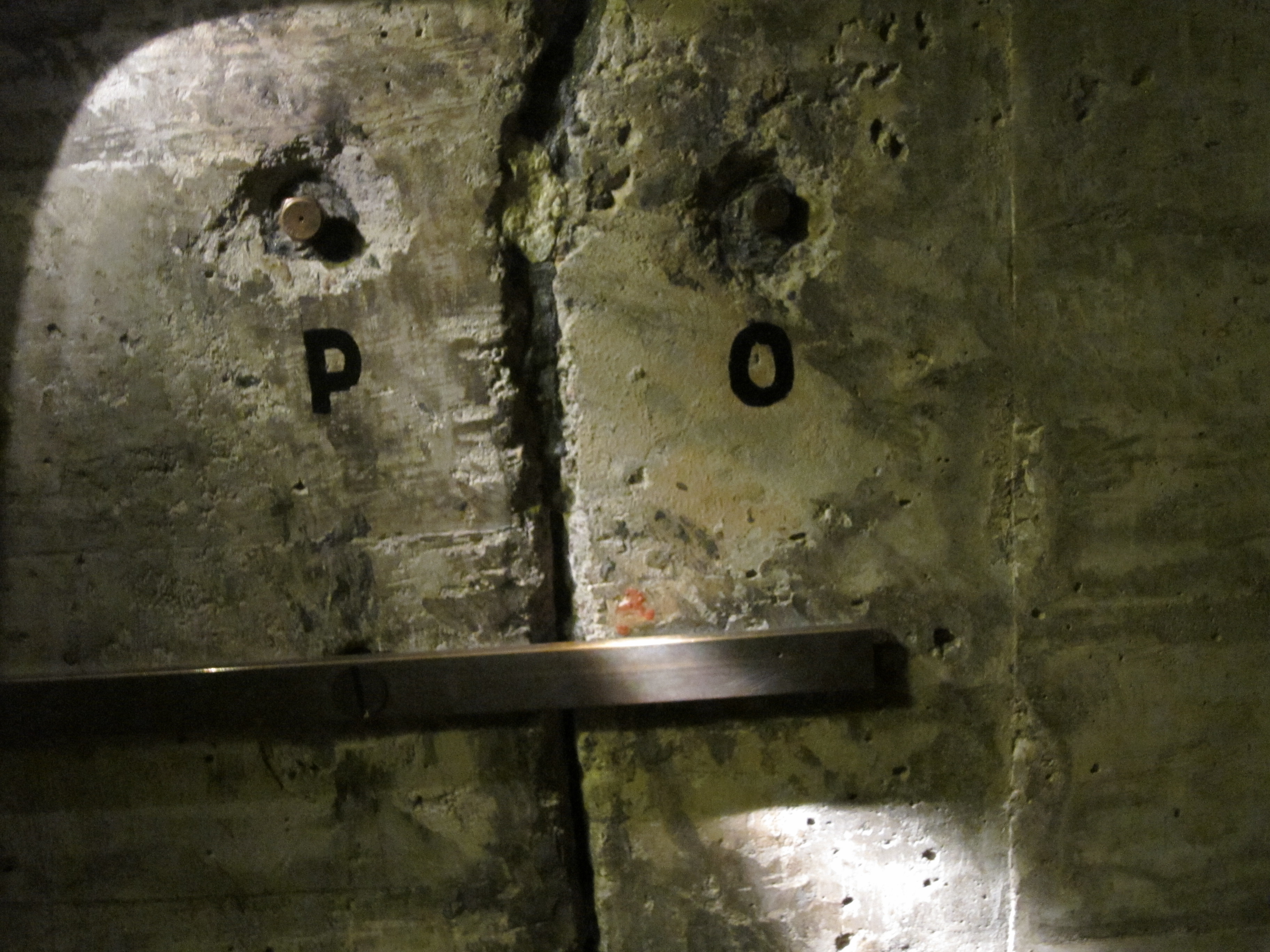
Dad will need to comment here. It is a brass plate holding two concrete segments together and the guide was very insistent on saying how little spade was behind the plate.
Dad will need to comment here. It is a brass plate holding two concrete segments together and the guide was very insistent on saying how little spade was behind the plate.
Comments
Concrete was poured in rectangular "boxes" which were 5' high. The production goal was to pour 1 box per box column per day. The front was smooth (as above) but the sides were sawtooth shaped which made them interlocking. Above is column "P" and "o". The two machine bolts were driven in to be bench marks. The brass plate was installed after an earthquake to show the shift in the concrete. You could probably slip a thick piece of paper behind it on the O side. They inspect the concrete regularly for hairline cracks (they look like the ones in Catherine's beams). The cracks are marked and cataloged. Presently they are computerizing the logs and digitally scanning the cracks after a contractor, in scrubbing the walls, erased 70 years of notations. Each box had 1" water pipes so as to cool the concrete as it cured. The pipes have been sealed off. This was one of the many techniques which were invented for the dam. The engineers are still checking the concrete and amazingly, there is some which is still not fully cured after all these years.
— Peter Hovell
Regarding hairline cracks -- when we test beams, generally cracks of width 0.03 in. are present just before failure. There's a big difference between hairline (generally < 0.005 in.) width and 0.03 in., but even 0.03 will seem pretty small to the eye.
— Catherine Hovell