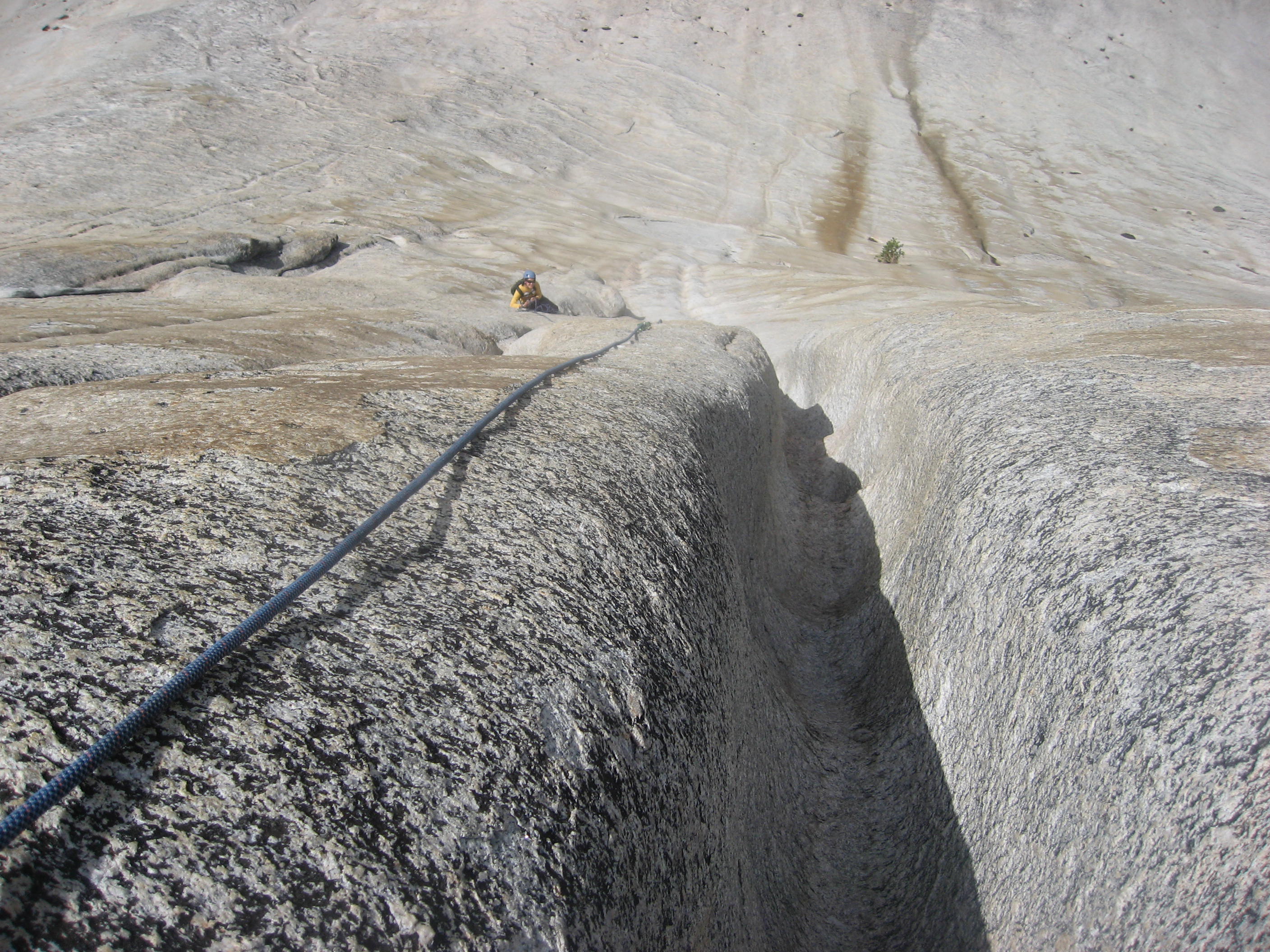
Another view of the size of the water crack (which just appears as a dark stain from the ground). I love how rock up close can end up being totally different from how it looks far away.
Another view of the size of the water crack (which just appears as a dark stain from the ground). I love how rock up close can end up being totally different from how it looks far away.
Comments
At what point do you start worrying about the abrasive action of the rock on the rope? (Spoken like a mother)
— Margaret Hovell
This is actually explained by looking at how a climbing rope works. A climbing rope has two main parts, a core and a sheath. As you might expect, the sheath surrounds the core, and except at the ends of the rope, the two are totally detached. What is not so obvious is that 100% of the rope's strength is derived from the core. The sheath's only purpose is to protect the core from damage. The core is white, and fibrous, and looks totally different from the shealth. On every pitch, the entire rope length is run through the belayer's hands and she has a chance to inspect the sheath for abrasion, or in an extreme case visibility of the core (a.k.a. a "core shot). Core shots don't normally occur from normal wear and tear but instead usually result from running the rope over a sharp edge and then weighting or moving the rope repeatedly, or an accident with a crampon/ice axe. This is something that climbers work very hard to avoid. If a core shot is discovered, there are special knots to take the injured part of the rope out of the system, while still using the rest, though ideally the rope is retired or turned into two shorter ropes ASAP (as soon as you can reach level ground). In this case pictured, there is minimal abrasion being dealt to the rope; it is unweighted and simply draped across relatively smooth granite. Make sense?
— John Hovell